MODAL VERBS
The modal verbs are:| can |
| could |
| may |
| might |
| will |
| shall |
| should |
| ought to |
| must/have to |
We use modal verbs to show if we believe something is certain, probable or possible (or not). We also use modals to do things like talking about ability, asking permission making requests and offers, and so on.
Should (Modals)
Should is used to give advice and to make recommendations. It is also used to express obligation and expectation.
Recommendation: When you go to London, you should go to the theatre.
Advice: You should try to focus more on your writing skills. Advice
Obligation: I should be going now. It's getting late.
Expectation: You should have understood the text by now.
Most modal verbs have different forms depending on their function when used in the present, past or future times.
To Offer of Assistance or Polite Suggestion (When you are quite sure of a positive answer)
Shall + subject + base form of the verb
To Offer of Assistance or Polite Suggestion (When you are not sure of a positive answer)
Should + subject + base form of the verb
A Prediction or Expectation that Something Will Happen
should/shouldn’t + base form of the verb
To Give Advice
should / ought to + base form of the verb
To Give Advice (about something you think wrong or unacceptable)
shouldn’t + base form of the verb
Examples:
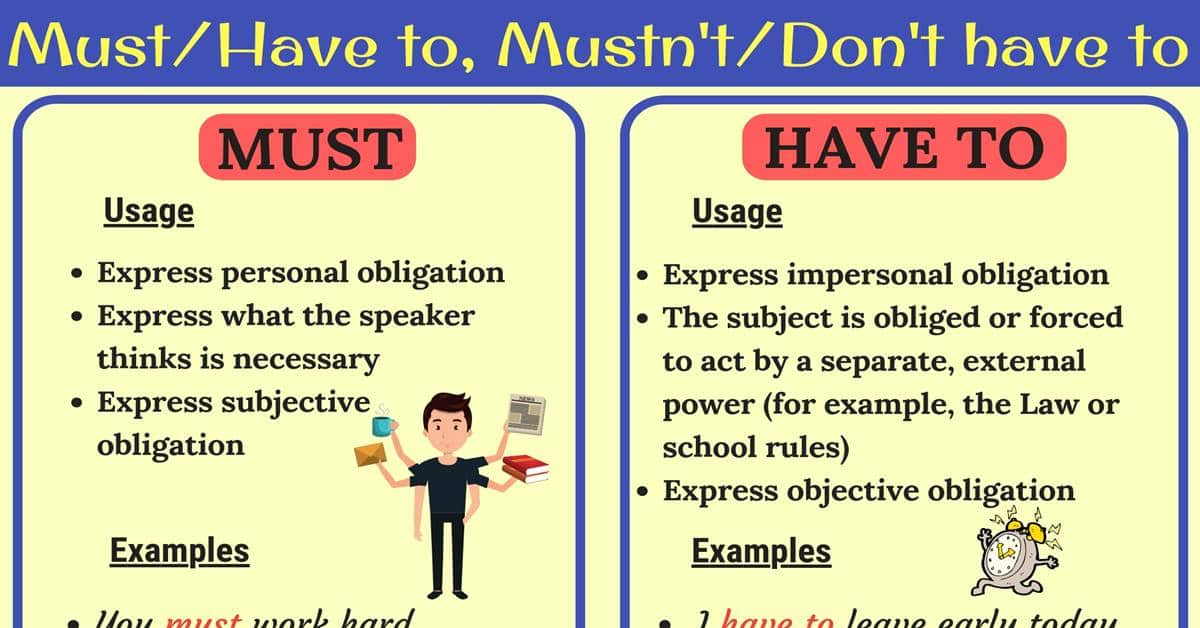
 Must vs. have to
Both Must and have to express obligation or necessity, but there are some small differences:
• Must expresses the speaker's feelings, whereas have to expresses, above all, an impersonal idea:
You must come. You are obliged to come (I require that you come)
You have to come. You are obliged to come. (There's a rule requiring you to come)
Must I wear this tie? Am I obliged to wear this tie? (What do you think?)
Do I have to wear this tie? Am I obliged to wear this tie? (Is there a rule about ties?)
• Have to mainly expresses general obligations, while must is used for specific obligations:
I have to brush my teeth twice a day.
I must tell you something.
Important: To express obligation, duty or necessity in the future or the past, must and need are not used. They are replaced by have to:
We must (need to) buy another ticket.
We had to buy another ticket yesterday.
We'll have to buy another ticket later.
However, in their negative forms, mustn't and don't have to have completely different meanings:
• Mustn't expresses prohibition
You mustn't drive. You are prohibited to drive. You are not allowed to drive.
• Don't have to expresses the absence of obligation or necessity:
You don't have to drive. You are not obliged to drive (but you can if you want to).
Present and Future:
must / have to / need to + base form of the verb
Past:
had to / needed to + base form of the verb
Almost 100% Certain
must + base form of the verb
To Persuade
must / have to + base form of the verb
Prohibited or Forbidden
must not / mustn’t + base form of the verb
Examples:
SOME EXERCISES:
|
Comentarios
Publicar un comentario